
Car Maintenance Checklist for Canadian Drivers
Monthly quick checks, mileage-based service, and the before-winter prep that actually prevents a roadside breakdown.
Quick answer
A complete car maintenance checklist covers 4 things: monthly quick checks (tire pressure, lights, wiper fluid), mileage-based service (oil, filters, brakes, following your owner's manual), seasonal prep (battery and winter tires before cold weather, AC and coolant before summer), and the warning signs that mean stop deferring and see a mechanic. Following it prevents most roadside breakdowns and the expensive repairs that come from deferred small issues.
Want this as a printable PDF? It's free.
We'll email you Car Maintenance Checklist for Canadian Drivers formatted for 8.5×11, ready to print.
Most roadside breakdowns and expensive repairs trace back to a small check that got skipped, not a sudden failure. This checklist splits car maintenance into what to check monthly, what's due by mileage, and what's due by season — so nothing depends on remembering a date.
Monthly quick checks (10 minutes)
- Tire pressure, including the spare — check when tires are cold, before driving
- Tire tread depth — the legal minimum across Canada is 1.6 mm; replace well before you hit it
- All exterior lights: headlights, tail lights, brake lights, turn signals, reverse lights
- Windshield washer fluid level — top up with a winter-rated fluid once temperatures drop below freezing
- Wiper blades — replace at the first sign of streaking or skipping, not once they're unusable
- Dashboard warning lights — note anything new, even if it clears on its own
- Visible fluid leaks under the vehicle after it's been parked overnight
Mileage-based service
- Oil and filter change — follow your owner's manual or the vehicle's oil-life monitoring system; conventional oil is commonly 5,000–8,000 km, full synthetic often stretches to 10,000–16,000 km, but the manufacturer's guidance overrides any general rule
- Tire rotation — typically every 8,000–12,000 km, or every second oil change, to even out wear
- Cabin air filter — typically every 20,000–25,000 km, sooner if you notice reduced airflow or odour
- Engine air filter — typically every 30,000–50,000 km, sooner in dusty or gravel-road conditions
- Brake pad inspection — have thickness checked at every tire rotation; don't wait for the squeal
- Coolant/antifreeze — follow the manufacturer's interval, commonly every 5 years or 100,000–150,000 km for long-life coolant
- Transmission fluid — interval varies widely by vehicle; confirm in the owner's manual rather than assuming it's "lifetime"
Before winter
- Install winter tires once daily highs sit consistently under 7°C
- Have the battery load-tested — cold weather is when a marginal battery finally fails, and testing in October beats a dead battery in January
- Switch to winter-rated windshield washer fluid, rated well below your coldest expected temperature
- Check coolant concentration — it needs to be a genuine antifreeze mix, not mostly water, to protect against a hard freeze
- Check the block heater cord and outlet if your vehicle has one — a common no-start cause in extreme cold is a dead cord, not the engine
- Pack a winter emergency kit: blanket, shovel, sand or kitty litter for traction, warning triangle, flashlight, first aid kit, and a full tank of gas kept above half all season
Before summer / road trip season
- Have the AC system checked if airflow feels weak — refrigerant loss is gradual and easy to miss until it's hot out
- Check tire pressure again — pressure shifts with the seasonal temperature swing, not just from slow leaks
- Inspect wiper blades and washer fluid after a winter of salt and grit
- Check the battery terminals for corrosion buildup from winter road salt
- Reverse winter tires once nightly lows are consistently above freezing
- Top up or replace old windshield washer fluid with a summer bug-and-tar formula
Warning signs that mean see a mechanic now
- Squealing or grinding when braking — brake wear indicators are designed to squeal before the pads are metal-on-metal
- A new dashboard warning light that doesn't clear after a drive cycle
- Pulling to one side under braking or while driving straight
- A burning smell, especially after highway driving
- Any fluid leak that's new, growing, or a colour other than clear (water/condensation from AC is normal)
- A check engine light that's flashing rather than steady — that's an active-damage warning, not a "get to it eventually" one
Registration & insurance
- Confirm your registration renewal date and method — this is set provincially, not federally, so the process varies by where you live
- Renew insurance before the expiry date, and re-shop for a quote rather than auto-renewing every year
- Check whether your province requires an emissions or safety inspection for your specific situation — most of Canada doesn't require a routine annual inspection, but many provinces require one when a used vehicle changes ownership or after a collision
- Update your insurer if your annual mileage, commute, or primary driver changes — misreporting can affect a claim
Practical tips
- Keep a simple log — date, mileage, what was done — even a notes app entry. It's the fastest way to know what's actually due.
- A pre-trip check before any long drive (tires, fluids, lights) takes 5 minutes and catches most issues that would otherwise strand you.
- Deferred maintenance is rarely cheaper — a $40 cabin air filter ignored doesn't cost more later, but a skipped oil change or ignored brake wear usually does.
Sources
Deadlines, dollar figures, and thresholds above were checked against these sources — July 2026. Rules change; always confirm current figures at the link before relying on them.
This page is free. Here is what CA$7 adds.
Monthly checks, mileage-based service, and seasonal prep — built around your vehicle, province, and how much you drive.
Free · this page
Car Maintenance Checklist for Canadian Drivers
- Every item on this page
- Printable PDF by email (free)
- Same list for every household
- No spreadsheet to track progress
Personalized · CA$7 one-time
Car Maintenance Checklist
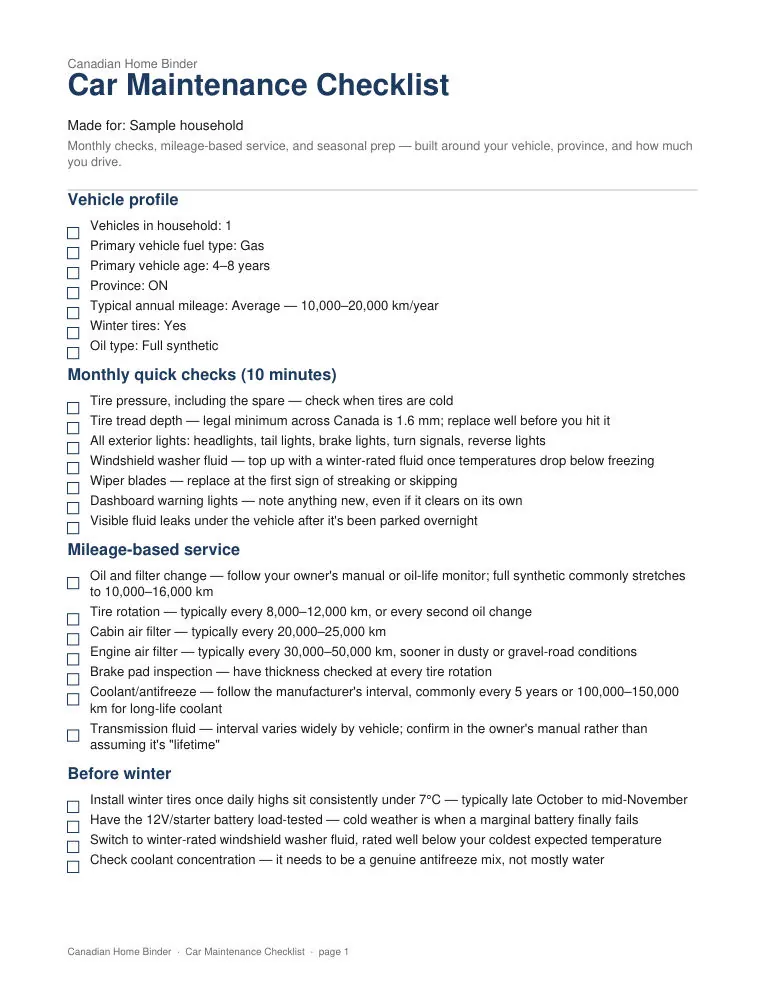
- Built from 8 quick questions about your home
- Only the steps that apply to you, in your order
- Printable PDF, formatted for 8.5×11
- Editable Excel / Google Sheets tracker
- Regenerate any time for 30 days
PDF ExcelReady in seconds after checkout14-day make-it-right guarantee
Get the free PDF first and we'll email you 15% off the personalized version (Car Maintenance Checklist).
Get the Complete Canadian Life Admin Bundle
Get every binder and every personalized checklist we offer. Your bundle includes personalized versions built around your household, plus the original ready-to-use binder PDFs.
Shop the BundleFrequently asked questions
Follow your owner's manual or your vehicle's oil-life monitoring system if it has one. As a general range, conventional oil is commonly 5,000–8,000 km and full synthetic often stretches to 10,000–16,000 km, but manufacturer guidance always overrides a general rule.
Related checklists
- Camping Checklist for Canadian Trips
Shelter, kitchen, clothing, and the bear-safe food storage rules Canadian backcountry actually requires.
- Home Inspection Checklist for Canadian Buyers
What's included by default, what's an add-on, and the questions that matter more than the report's length.
- Winter Prep Home Checklist for Canadian Homes
The full October-to-November prep list to keep your Canadian home warm, dry, and safe all winter — plus the HVAC vent-clearing step most checklists miss.
- Cottage Closing Checklist
Close the cottage properly so nothing bursts, freezes, or gets chewed over winter.