
Winter Prep Home Checklist for Canadian Homes
The full October-to-November prep list to keep your Canadian home warm, dry, and safe all winter — plus the HVAC vent-clearing step most checklists miss.
Quick answer
A Canadian winter home prep checklist covers 6 areas before first frost: (1) heating (furnace tune-up, filter, thermostat, chimney), (2) water lines (drain exterior taps, insulate pipes in cold rooms, test sump pump), (3) building envelope (roof, eaves, weatherstripping, attic hatch), (4) safety alarms (smoke + CO, batteries, fire extinguisher), (5) exterior + car (snow tires, salt, shovels for both the house and each vehicle), and (6) emergency readiness (72-hour kit, generator, alternate heat). Add a standing habit of clearing snow away from your furnace and water heater's exterior exhaust vents after every snowfall — a blocked vent can shut the furnace down or cause a CO backup. Aim to finish by mid-November in most of Canada.
Want this as a printable PDF? It's free.
We'll email you Winter Prep Home Checklist for Canadian Homes formatted for 8.5×11, ready to print.
Canadian winters are hard on houses. Freeze-thaw, ice dams, wind-driven snow, and a 6-month heating season punish anything that wasn't sealed, serviced, or drained in fall. This checklist takes one weekend and prevents most winter emergencies.
Heating system + chimney
- Book a professional furnace or heat-pump tune-up (annual, before first cold snap)
- Replace the furnace filter; note the size + date on the filter itself
- Test the thermostat — set a programmable schedule or verify smart thermostat firmware
- Vacuum baseboard heaters and unblock all supply + return registers
- Have the chimney and wood stove inspected + swept before first fire
- Stack firewood off the ground, at least 30 cm from the house, covered on top only
- Verify natural-gas or propane shutoff location and that the tool is nearby
- For heat pumps: clear the outdoor unit; keep 60 cm clearance for airflow and snow
Keep HVAC & water heater exterior vents clear of snow
- Locate your high-efficiency furnace's intake and exhaust vent pipes — usually PVC, low on an exterior wall — and know exactly where they terminate
- After every snowfall, clear snow and ice away from these vents before running the furnace — a blocked exhaust can shut the furnace down or cause a dangerous CO backup into the house
- If you have a high-efficiency (power-vented) water heater, check whether it vents separately from the furnace and clear that vent too
- Keep at least 30 cm (12 in) clear around every exterior vent termination — more once a snowdrift starts forming against that wall
- The dryer vent has the same snow-blockage risk, just a different symptom — a dryer that stops drying properly
Pipes + water system
- Shut off exterior taps at the interior shutoff; drain the outside spigot
- Disconnect, drain, and store garden hoses
- Insulate any pipes running through unheated spaces (garage, crawlspace, exterior walls)
- Test the sump pump and battery backup; confirm the discharge line isn't frozen or blocked
- Locate the main water shutoff — tag it and make sure everyone in the house knows where it is
- Drain and blow out the irrigation system
- Check the water heater: pilot / burner working, no rust, temperature 49–60°C
- Add a rock-salt-safe mat inside the front door to protect flooring from boots
Roof, eaves, and building envelope
- Clean eavestroughs after leaves drop; check downspout drainage 6 ft from the house
- Inspect the roof from the ground with binoculars for lifted shingles or flashing
- Look for signs of ice-dam risk (heat loss patterns, missing attic insulation)
- Re-caulk gaps around windows, doors, and pipe penetrations
- Replace worn weatherstripping on doors and the attic hatch
- Confirm attic insulation is R-50+ and the hatch is insulated + sealed
- Reverse ceiling fans to clockwise (low speed) to push warm air down
- Close crawlspace and foundation vents that aren't required year-round
Smoke, CO, and fire safety
- Test every smoke alarm and CO alarm with the button
- Replace batteries at daylight-saving change (November clock change is the reminder)
- Replace any alarm older than 7–10 years (check manufacture date on the back)
- Confirm ABC fire extinguisher in kitchen + near the furnace, pressure gauge in green
- Review the family escape plan and practice with kids
- Never run a car, generator, or BBQ in an attached garage
- Check dryer vent for lint buildup outside and inside
Outside + car
- Swap to winter tires by the time temperatures drop below 7°C (required in Quebec + parts of BC)
- Top up antifreeze, washer fluid; check wipers and lights
- Assemble a car winter kit: blanket, snacks, water, flashlight, jumper cables, small shovel
- Install driveway markers before the ground freezes
- Stock salt, sand, and shovels near every exterior door; service the snowblower
- Store patio furniture and cushions; empty and flip planters
- Trim branches over the roof and driveway that could break under ice load
Boat, RV, shed & pool house
- Boat: fog the engine or stabilize the fuel, drain all water systems completely, disconnect or trickle-charge the battery, and cover it — a hull with water still in it is the most expensive mistake here
- RV or trailer: drain fresh/grey/black tanks, add RV antifreeze to every line and trap, and cover the tires
- Shed: clear the roof of debris before snow load builds, check door seals, and move anything that could freeze and crack (paint, garden chemicals) to a heated space
- Pool house or cabana: winterize its plumbing exactly like the main house, and store pool equipment and chemicals indoors
- Patio furniture: clean and fully dry everything before storing — packing it away wet is how mildew and rust set in over winter
Emergency readiness + backup power
- Refresh the 72-hour kit: water (4L per person per day), food, meds, radio, flashlight
- Add extra blankets, hand warmers, and a battery pack for phones
- Test any generator: fuel, oil, transfer switch, extension cords rated for outdoor use
- Confirm alternate heat source (wood stove, propane heater) has fuel and a CO alarm nearby
- Print emergency contacts (utility, plumber, roofer) and post them inside a cupboard
- Register for Alert Ready + provincial + municipal emergency alerts
- Confirm home insurance covers frozen-pipe damage and sewer backup
Practical tips
- Do the full prep on one weekend before Halloween — most of Canada hits first frost between late October and mid-November.
- Take dated photos of the roof, eaves, and foundation each fall. Comparison photos catch slow damage insurance will otherwise dispute.
- Keep interior humidity at 30–40% in winter. Higher, and windows drip and mould grows; lower, and floors + trim crack.
This page is free. Here is what CA$7 adds.
Fall-into-winter prep tailored to your home — plumbing, HVAC vents, and every outdoor thing you own that winter can damage.
Free · this page
Winter Prep Home Checklist for Canadian Homes
- Every item on this page
- Printable PDF by email (free)
- Same list for every household
- No spreadsheet to track progress
Personalized · CA$7 one-time
Winter-Prep Home Checklist
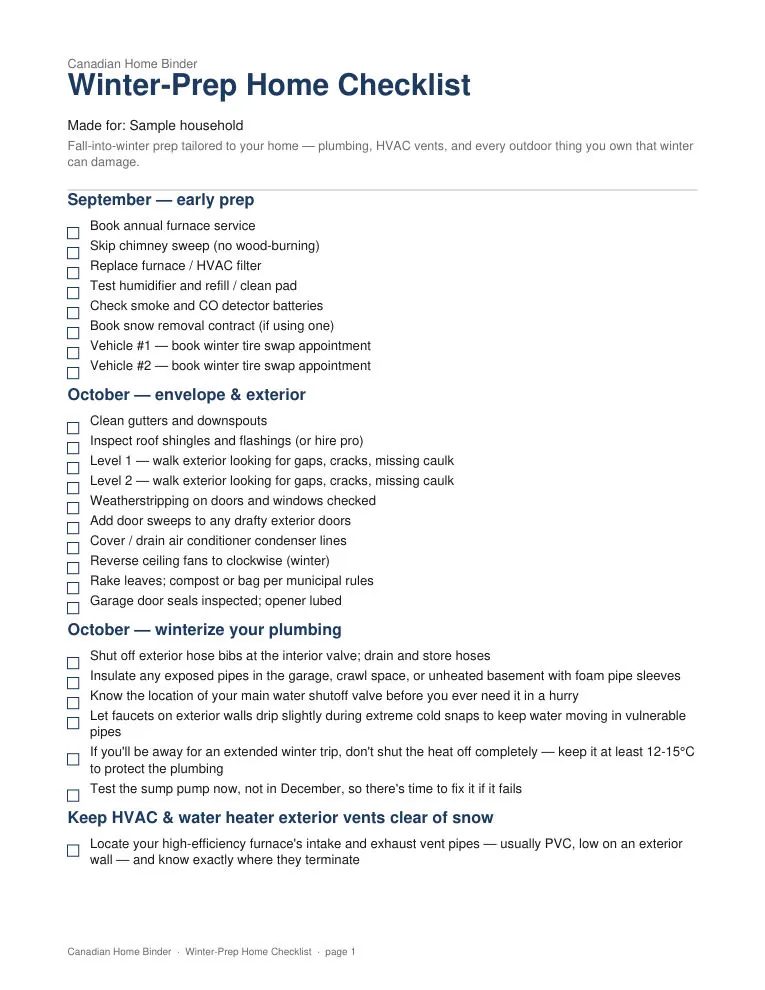
- Built from 12 quick questions about your home
- Only the steps that apply to you, in your order
- Printable PDF, formatted for 8.5×11
- Editable Excel / Google Sheets tracker
- Regenerate any time for 30 days
PDF ExcelReady in seconds after checkout14-day make-it-right guarantee
Get the free PDF first and we'll email you 15% off the personalized version (Winter-Prep Home Checklist).
Get the Complete Canadian Life Admin Bundle
Get every binder and every personalized checklist we offer. Your bundle includes personalized versions built around your household, plus the original ready-to-use binder PDFs.
Shop the BundleFrequently asked questions
Before first hard frost — usually mid-October in the Prairies and Northern Ontario, late October in Southern Ontario and Quebec, and early November on the coasts. Aim to finish 2 weeks before the average first-frost date for your region.
Related checklists
- Camping Checklist for Canadian Trips
Shelter, kitchen, clothing, and the bear-safe food storage rules Canadian backcountry actually requires.
- Home Inspection Checklist for Canadian Buyers
What's included by default, what's an add-on, and the questions that matter more than the report's length.
- Car Maintenance Checklist for Canadian Drivers
Monthly quick checks, mileage-based service, and the before-winter prep that actually prevents a roadside breakdown.
- Cottage Closing Checklist
Close the cottage properly so nothing bursts, freezes, or gets chewed over winter.
From the blog
- Best Winter Home Prep Products (2026)
Ice dams and frozen pipes are two of the most expensive winter repair calls in Canada, and both are largely preventable. A roof rake, a deicing cable, and a pipe heat cable.
- Winter Home Prep in Canada: A Fall Checklist
The fall jobs Canadian homeowners can knock off in a weekend that quietly prevent thousands of dollars in winter repairs.
- Winter Tire Changeover Cost in Canada 2026
When to book, where to go, what to pay, and the provincial rules that decide whether it's a choice or the law.