
Family Emergency Binder Checklist
The 7 sections every Canadian emergency binder needs, and what goes in each.
Quick answer
A Canadian family emergency binder should have 7 sections: identity documents, medical information, insurance policies, financial accounts, household + property records, emergency contacts, and end-of-life documents (will, POA, funeral wishes). Keep one printed copy at home and one encrypted digital copy off-site.
Want this as a printable PDF? It's free.
We'll email you Family Emergency Binder Checklist formatted for 8.5×11, ready to print.
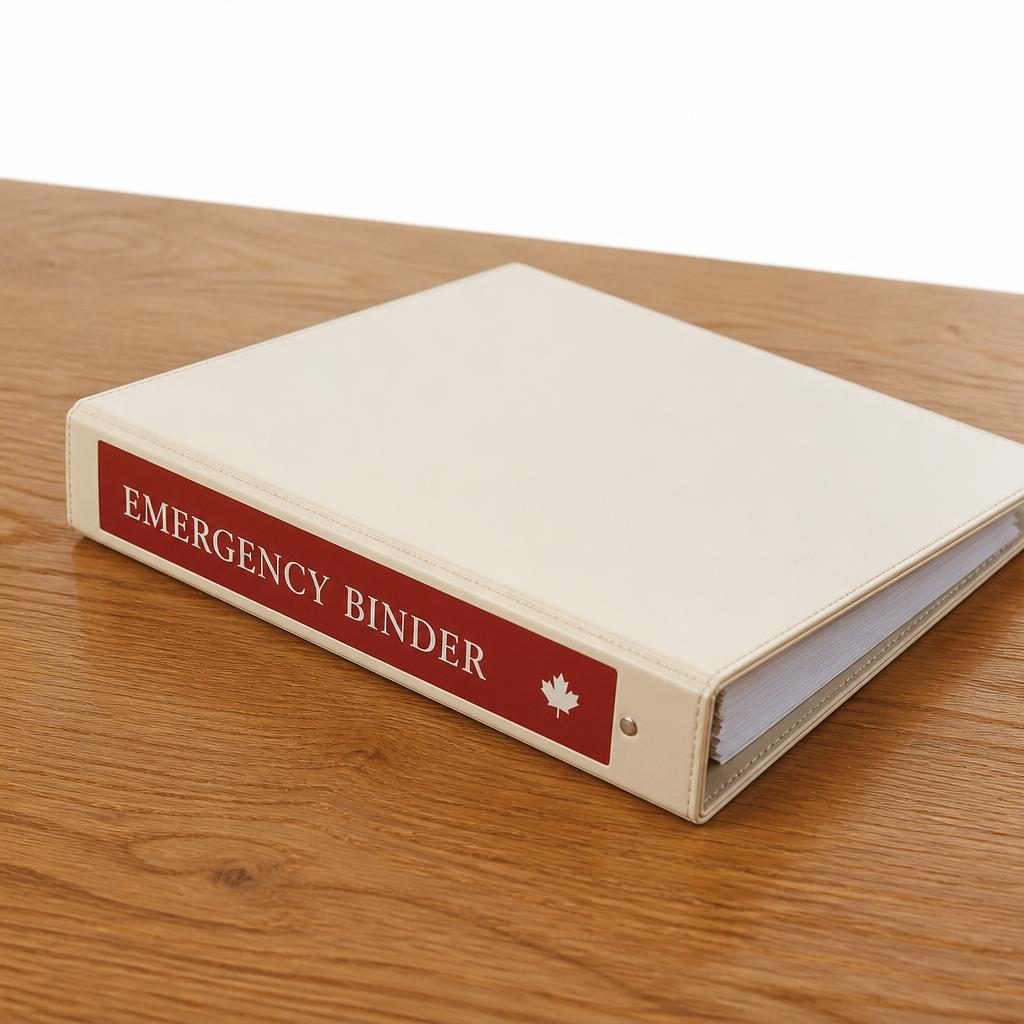
An emergency binder isn't paranoid — it's a gift to whoever has to step in during a hospital stay, a house fire, a natural disaster, or worse. The goal: another adult can pick up this binder and run your household without asking a single question.
Identity documents
- Birth certificates (originals + certified copies)
- SIN cards (each family member)
- Passports and NEXUS cards
- Driver's licences and health cards
- Citizenship or PR cards
- Marriage certificate; divorce decree if applicable
- Child custody or guardianship paperwork
Medical information
- Health card numbers for each family member
- Family doctor + specialist contact info
- Current medications, dosages, and pharmacy
- Allergies (food, medication, environmental)
- Immunization records
- Blood type and known conditions
- Advance care directive / living will if you have one
Insurance policies
- Home or tenant insurance (policy #, broker, contact)
- Auto insurance for each vehicle
- Life insurance policies (insurer, policy #, beneficiary)
- Disability and critical illness coverage
- Extended health and dental (group + individual)
- Travel insurance provider
Financial accounts
- Bank accounts (institution, transit, account #)
- Credit cards (issuer, last 4, phone #)
- Mortgage / line of credit / auto loan details
- Investment accounts (RRSP, TFSA, RESP, non-registered)
- Pension and CPP/OAS info
- Employer payroll + HR contact
- Location of tax records and CRA My Account details (do NOT write passwords — use a password manager)
Property + household
- Vehicle ownership + VINs
- Property tax and utility account numbers
- Home warranty and appliance manuals
- Contractor + landlord contacts
- Alarm codes (kept separately, referenced only)
Emergency contacts
- Two out-of-town relatives (in case local lines are down)
- Neighbours with a spare key
- Kids' schools and daycare
- Employer emergency contact
- Vet + pet emergency clinic
- Executor of will
Will + end-of-life
- Location of the original will (lawyer's office or safe)
- Powers of attorney for property and personal care
- Funeral or celebration-of-life wishes
- Organ donor status
- Digital-legacy instructions (who accesses accounts)
Practical tips
- Keep the binder in a fire-rated safe or a bag near an exit. Tell two people where it is.
- Store a second copy on an encrypted USB with a trusted family member outside your city.
- Review every January — dates, meds, and beneficiaries drift.
- Never write full passwords in a paper binder. Use a password manager and note the manager's master-password recovery instead.
Want the printable version?
Get the matching printable binder — a one-time purchase, no subscription. Your download link is active for 30 days; the files are yours to keep and reprint.
Get the Complete Canadian Life Admin Bundle
Get every binder and every personalized checklist we offer. Your bundle includes personalized versions built around your household, plus the original ready-to-use binder PDFs.
Shop the BundleFrequently asked questions
Fire-rated safe or a grab-and-go bag near an exit. Store a second copy off-site with a trusted family member.
Related checklists
- Travel & Vacation Checklist for Canadian Travellers
The packing list, plus the Canada-specific parts most checklists skip — provincial health coverage abroad, CBSA limits, and passport validity.
- Marriage Checklist for Canadian Couples
Not the wedding-planning checklist — the legal one. The licence, common-law vs. married, and what actually needs updating after.
- Estate Planning & Executor Checklist for Canadian Families
Getting your own affairs in order, and what an executor actually does after a death — in the order it actually needs to happen.
- Important Documents Checklist for Canadian Households
The five categories of documents every Canadian family needs on file, and how long to keep them.
From the blog
- Best Power Outage & Emergency Gear (2026)
Weatheradio Canada was shut down in March 2026 — here's what that actually changes, plus a radio, a lantern, and a power station that cover what still matters in a power outage.
- The 72-Hour Emergency Kit for Canadian Households
Water, food, meds, documents, warmth — and the family plan that turns a bin of stuff into something you can actually use.