
Year-End Tax & Finance Checklist for Canadians
The four-month runway from December to the April 30 filing deadline — contributions, receipts, slips, self-employed/gig/crypto income, and CRA setup — in one printable checklist.
Quick answer
A Canadian year-end tax checklist runs from December through April 30. Key steps: (1) December — top up RRSP, TFSA, FHSA, and RESP contribution room; harvest capital losses by Dec 27; make charitable donations by Dec 31. (2) January — set up or confirm CRA My Account and Auto-fill My Return. (3) February — collect T4, T5, T3, T4A, RRSP contribution slips, and medical/child-care receipts. (4) March 2, 2026 — RRSP deadline for the 2025 tax year. (5) April 30 — file your return and pay any balance owing. Self-employed filers get until June 15 to file but still owe by April 30. Add crypto, foreign property (T1135), newcomer, and first-time home buyer steps if any apply to you.
Want this as a printable PDF? It's free.
We'll email you Year-End Tax & Finance Checklist for Canadians formatted for 8.5×11, ready to print.
Canadian tax season quietly starts in December — every dollar of RRSP room, capital loss, or charitable donation locked in before year-end changes what you owe in April. This checklist runs Dec–April so nothing is missed.
December moves (before year-end)
- Top up TFSA to the annual limit (unused room carries forward, but current-year deposits count now)
- Contribute to your RESP by Dec 31 to trigger this year's CESG (20% match, up to $500)
- Top up FHSA if you're saving for a first home (up to $8,000/year)
- Sell losing non-registered investments by Dec 27, 2025 for a capital loss (T+2 settlement)
- Complete charitable donations by Dec 31 for a receipt in this tax year
- Pay quarterly instalments if you're on the CRA schedule (Dec 15)
- Book any remaining medical, dental, or vision appointments if you're near the 3% threshold
- Small business owners: pay year-end bonuses / dividends and remit payroll
January — set up your CRA + tools
- Log into CRA My Account (or create one — takes 5–10 business days for a security code)
- Confirm your direct-deposit info in CRA My Account
- Enable Auto-fill My Return in your tax software
- Pick your tax software: Wealthsimple Tax, TurboTax, StudioTax, or a local accountant
- Check the 2025 federal + provincial tax brackets against your income
- Confirm your marital + dependant status for the year
T-slips + receipts to collect (mostly by end of February)
- T4 — employment income (employer must issue by Feb 28)
- T4A — self-employment, scholarships, RESP withdrawals, some pensions
- T5 — investment income (interest, dividends) from banks and brokerages
- T3 — trust and mutual-fund distributions (often issued late March)
- T5008 — securities transactions (for capital gains / losses)
- T2202 — tuition (from your college or university)
- RRSP contribution receipts (first 60 days of the year get their own slip)
- Medical receipts, prescriptions, and travel logs for medical expenses
- Child-care receipts + provider SIN or business number
- Charitable donation receipts (keep the paper or PDF copy)
- Rent receipts or property-tax bill (for provincial credits in ON, MB, QC)
Self-employed, gig economy & crypto
- Self-employed and freelancers: filing deadline is June 15, but any balance owing is still due April 30 — interest accrues from May 1 regardless
- Business receipts sorted by category as you go (COGS, office, meals at 50%, travel, home-office %, phone) — not reconstructed in April
- Vehicle log: personal vs business kilometres with dates, kept contemporaneously — CRA can and does ask for this
- GST/HST registration and remittance on schedule once you're past the small-supplier threshold
- CPP contributions tracked — self-employed pay both the employer and employee share, which surprises a lot of first-year freelancers
- Quarterly instalment payments planned if you owed more than the CRA's instalment threshold last year
- Gig economy (rideshare, delivery, freelance platforms): collect T4A or year-end income summaries from every platform you worked for, not just the main one
- Cryptocurrency: full transaction history exported from every exchange and wallet — adjusted cost base tracking is your responsibility, not the exchange's
- Crypto disposals — including trading one coin for another, and paying for something with crypto — are all taxable events, not just cashing out to CAD
- Foreign income or foreign property over $100,000 CAD at any point in the year: Form T1135 is required, and the penalty for skipping it is disproportionate to how easy the form is to file
Newcomer, student, retired, or first-time home buyer
- Newcomer to Canada: your residency start date determines whether you report only Canadian income or your full world income for the year — get this right before anything else
- Newcomer to Canada: you won't have a prior Notice of Assessment or RRSP/FHSA room in year one — both build starting this tax year
- Newcomer to Canada: apply for the GST/HST credit and Canada Child Benefit as soon as you're eligible — neither is automatic on a first return
- Student: T2202 tuition slip, plus transferring any unused tuition credit to a parent or spouse if you don't need it all yourself
- Student: keep the annual student loan interest statement — it's a non-refundable credit most students forget to claim
- Retired: pension income splitting with a spouse can lower your combined tax bill — most tax software calculates the optimal split automatically
- Retired: track net income against the OAS recovery threshold (published annually by CRA) — going over triggers a clawback on Old Age Security
- First-time home buyer this year: confirm your FHSA contributions against both the annual and lifetime limits
- First-time home buyer this year: if you used the Home Buyers' Plan, note the RRSP repayment schedule starts the second year after withdrawal and runs 15 years
- Moved provinces this year: your province of residence on December 31 taxes your full year's income, regardless of where you lived for most of it
Deductions + credits Canadians commonly miss
- Home office expenses (T2200 signed by employer, actual-cost method)
- Union or professional dues
- Moving expenses (if you moved 40+ km closer to work or school)
- First-Time Home Buyers' Tax Credit — check the current-year claim amount, since it's periodically adjusted
- Multigenerational Home Renovation Tax Credit for a qualifying secondary suite
- Canada Training Credit — accumulated room shown on your Notice of Assessment
- Disability Tax Credit (DTC) — including transfers from a dependant, and RDSP contributions if newly approved
- Public transit passes for seniors (some provincial credits still exist)
- Digital news subscription tax credit
- Foreign tax paid on non-registered investments — avoid double taxation via the foreign tax credit
Filing + paying (March 2 + April 30)
- RRSP contribution deadline for 2025 tax year: March 2, 2026
- File your return by April 30, 2026 (June 15 if self-employed, but balance is still due April 30)
- Pay any balance owing by April 30 to avoid interest
- Set up pre-authorized debit or pay via online banking (CRA payee)
- Review your Notice of Assessment (NOA) when it arrives — check RRSP + TFSA room for next year
- If you owe > $3,000 two years in a row, expect CRA quarterly instalments next year
- Keep tax records for 6 years
Set yourself up for next year
- Update payroll TD1 if your dependants or credits changed
- Automate monthly RRSP, TFSA, FHSA, RESP contributions
- Track medical, charitable, and child-care receipts in one folder as you go
- Book a mid-year check-in for October to project your bracket + estimate April balance
- Add tax dates to your calendar: Mar 2, Apr 30, Jun 15, quarterly instalments
- Refresh estate + beneficiary designations on RRSP, TFSA, RESP, and life insurance
Practical tips
- The last trading day for a 2025 capital loss is around Dec 27 — Canadian and US settlement is T+2, so an order placed on Dec 30 settles in January and doesn't count.
- Charitable donation credit jumps above $200 — bunching two years of giving into one calendar year can boost your credit.
- Do a mid-year tax check every October. Course-correcting in Q4 (RRSP top-up, capital loss, charitable gift) is the difference between an April refund and an April bill.
Sources
- CRA — Important dates for RRSPs, RRIFs, RDSPs
- CRA — How long should you keep your income tax records?
Deadlines, dollar figures, and thresholds above were checked against these sources — July 2026. Rules change; always confirm current figures at the link before relying on them.
This page is free. Here is what CA$12 adds.
Close out the Canadian tax year on your terms — month by month, matched to your income, your family, and your province.
Free · this page
Year-End Tax & Finance Checklist for Canadians
- Every item on this page
- Printable PDF by email (free)
- Same list for every household
- No spreadsheet to track progress
Personalized · CA$12 one-time
Year-End Tax & Finance Checklist
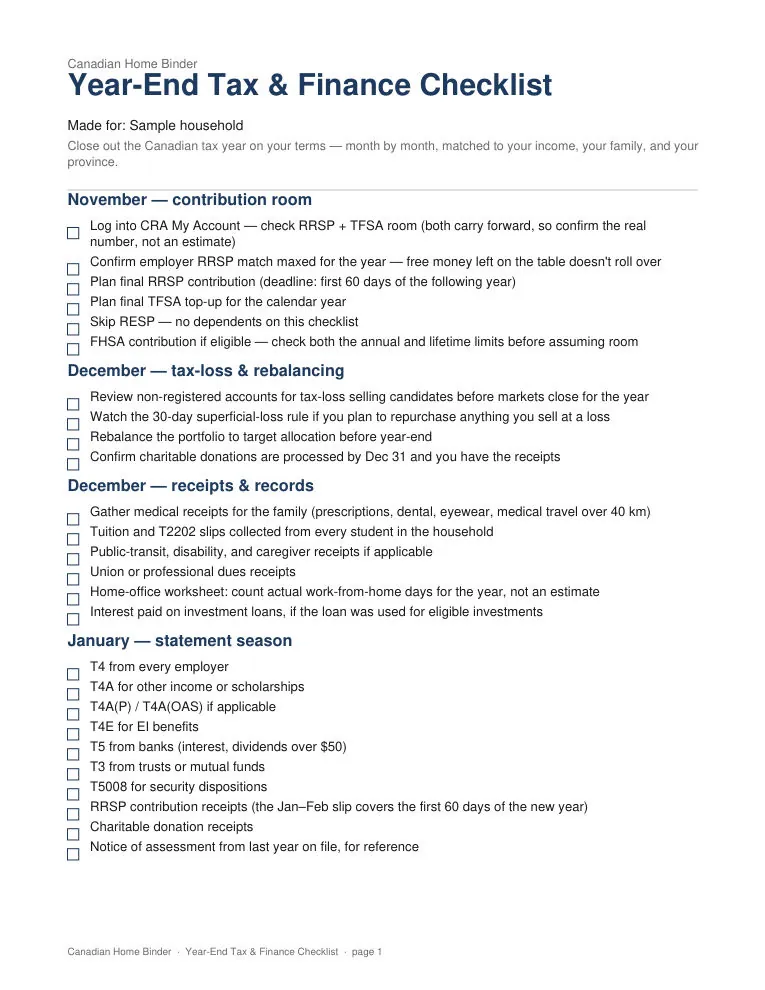
- Built from 6 quick questions about your home
- Only the steps that apply to you, in your order
- Printable PDF, formatted for 8.5×11
- Editable Excel / Google Sheets tracker
- Regenerate any time for 30 days
PDF ExcelReady in seconds after checkout14-day make-it-right guarantee
Get the free PDF first and we'll email you 15% off the personalized version (Year-End Tax & Finance Checklist).
Get the Complete Canadian Life Admin Bundle
Get every binder and every personalized checklist we offer. Your bundle includes personalized versions built around your household, plus the original ready-to-use binder PDFs.
Shop the BundleFrequently asked questions
March 2, 2026. The deadline is 60 days after the end of the tax year, which lands on March 1 — but since March 1, 2026 is a Sunday, it moves to the next business day, Monday March 2. Contributions made by that date can be claimed on your 2025 return.
Related checklists
- Travel & Vacation Checklist for Canadian Travellers
The packing list, plus the Canada-specific parts most checklists skip — provincial health coverage abroad, CBSA limits, and passport validity.
- Camping Checklist for Canadian Trips
Shelter, kitchen, clothing, and the bear-safe food storage rules Canadian backcountry actually requires.
- Marriage Checklist for Canadian Couples
Not the wedding-planning checklist — the legal one. The licence, common-law vs. married, and what actually needs updating after.
- Estate Planning & Executor Checklist for Canadian Families
Getting your own affairs in order, and what an executor actually does after a death — in the order it actually needs to happen.
From the blog
- RRSP, TFSA & FHSA Deadlines Canadians Should Know
The 60-day rule that decides your real RRSP deadline, and the current TFSA and FHSA limits — the numbers year-end tax prep actually runs on.
- Year-End Tax Prep for Canadians: Slips & Receipts
Which slips arrive when, what to keep, and the credits Canadian families quietly leave on the table every year.