
New Baby Prep Checklist for Canadian Parents
Everything a Canadian family needs to line up before baby arrives — medical, financial, gear, baby-proofing, postpartum recovery, and the first month home.
Quick answer
A Canadian new baby prep checklist covers 5 phases: (1) first trimester (register with a doctor or midwife, take folic acid, tell your employer), (2) second trimester (book prenatal classes, plan EI parental leave, start the registry), (3) third trimester (hospital bag, install the car seat, freezer meals, postpartum recovery supplies), (4) hospital + birth registration (birth certificate, SIN, Canada Child Benefit application), and (5) the first 6 weeks (feeding rhythm, sleep safety, baby-proofing basics, postpartum recovery). Most parents start the checklist around week 12.
Want this as a printable PDF? It's free.
We'll email you New Baby Prep Checklist for Canadian Parents formatted for 8.5×11, ready to print.
Prepping for a baby in Canada is equal parts medical, financial, and logistical. This checklist sequences the decisions so nothing gets forgotten between the 12-week ultrasound and the drive home from the hospital.
First trimester (weeks 1 – 13)
- Confirm pregnancy with your family doctor, midwife, or a walk-in clinic
- Choose a care provider: family doctor, OB/GYN, or midwife (varies by province and availability)
- Start a prenatal vitamin with 0.4 mg folic acid daily
- Book the 10–13 week dating ultrasound and blood work
- Tell your employer in writing when you're ready — protects EI and job-return rights
- Review your benefits: short-term disability, top-up plans, and drug coverage
- Stop alcohol, cannabis, and smoking; review any prescriptions with your doctor
- Log symptoms and questions in one notebook or app for every appointment
Second trimester (weeks 14 – 27)
- Book the 18–22 week anatomy ultrasound
- Sign up for prenatal classes (in-person or online; many are free through public health)
- Apply for Service Canada's EI maternity + parental benefits online — allow 6 weeks
- Decide on EI: 12-month standard or 18-month extended parental leave
- Start the baby registry: car seat, crib, monitor, feeding gear, diapers
- Choose a pediatrician or confirm your family doctor takes newborns
- Plan childcare early — Canadian daycare waitlists run 12–24 months in most cities
- Update life insurance and name a guardian in your will
Third trimester (weeks 28 – 40)
- Pre-register at your delivery hospital or birthing centre
- Install the rear-facing car seat; get it checked at a free clinic (many fire stations offer this)
- Pack the hospital bag: health card, ID, phone charger, going-home outfit for baby, snacks
- Set up the nursery: firm crib mattress, tight-fitted sheet, nothing else in the crib
- Wash newborn clothes and swaddles in fragrance-free detergent
- Stock 2 weeks of freezer meals and household essentials
- Confirm your birth plan and share it with your care team + support person
- Learn infant CPR (Canadian Red Cross runs short courses)
- Discuss postpartum mental health warning signs with your partner
Hospital + birth registration (Canadian paperwork)
- Bring health card, photo ID, birth plan, and hospital bag
- Sign the Provincial Birth Registration form before you leave the hospital
- Apply for the birth certificate (province-issued — required for passport + benefits)
- Apply for baby's SIN (Service Canada) — often bundled with birth registration
- Apply for the Canada Child Benefit (CCB) via CRA — retroactive up to 11 months but do it early
- Add baby to provincial health coverage (OHIP, MSP, RAMQ, etc.)
- Add baby to any private drug + dental plan within the enrollment window (usually 30 days)
- Book the newborn hearing screen + first pediatrician visit within 1 week
Baby-proofing & car seat safety
- Outlet covers on every accessible plug — sliding plate covers, not the small cap style, which are a choking hazard themselves
- Cabinet and drawer locks in the kitchen and bathroom, especially anywhere cleaning supplies or medications live
- Safety gates at the top and bottom of every staircase — hardware-mounted at the top, pressure-mounted is fine at the bottom
- Anchor every dresser, bookshelf, and tall piece of furniture to the wall — tip-overs are a leading cause of preventable child injury
- Anchor or wall-mount the TV rather than relying on a stand alone
- Fireplace or wood stove: install a hearth gate before the baby is mobile
- Stove knob covers and a stove guard; fridge and appliance locks once your child gets curious
- Corner and edge guards on sharp furniture corners at head height for a new crawler
- Older kids at home: build a daily "toy sweep" habit — Lego, marbles, and other small parts are a top choking hazard for a baby who's started exploring
- Install the car seat rear-facing and get it inspected before your due date — many fire departments and EMS/paramedic services run free car seat clinics, so call your local fire hall to ask before booking a paid one
- Baby monitor positioned with all cords well out of reach of the crib — cord strangulation is a preventable risk
Postpartum recovery supplies
- Maternity/postpartum pads (heavy flow) — bleeding lasts several weeks regardless of delivery type
- Mesh disposable postpartum underwear
- A perineal irrigation bottle ("peri bottle") for gentle rinsing
- Witch hazel pads and padsicles for perineal swelling
- Nipple cream and nursing pads if breastfeeding
- Stool softener on hand — a common postpartum need that catches many new parents off guard
- For a planned C-section: high-waisted soft underwear that sits above the incision, incision care supplies as directed by your care team, and help arranged for the first 2 weeks (no stairs or lifting beyond baby)
- A robe or nightgown that opens easily for feeding, and a pillow for comfortable feeding positions
First 6 weeks at home
- Follow safe-sleep basics: baby on back, alone, in a crib or bassinet (Health Canada guidance)
- Log feeding, wet/dirty diapers, and sleep for the first 2 weeks
- Watch for jaundice, dehydration, and feeding trouble — call HealthLink / 811 with concerns
- Attend the 2-week and 6-week pediatric checkups; confirm the immunization schedule
- Schedule your own 6-week postpartum checkup — including mental health screening
- Accept help: meals, laundry, an hour of sleep — say yes
- Screen visitors for illness and vaccinations (whooping cough + flu shots for close family)
- Update your budget: diapers, formula (if used), and reduced income during leave
Practical tips
- Apply for EI parental benefits the week baby arrives — payments don't start until Service Canada processes the claim.
- Take a photo of the car seat installation before you leave the hospital. Bases loosen; the photo is your reference.
- The Canada Child Benefit is retroactive up to 11 months, but every month you delay is a month of missed payments.
This page is free. Here is what CA$9 adds.
From second trimester through the first three months — hospital bag, postpartum recovery, baby-proofing, and every piece of paperwork, personalized to your family.
Free · this page
New Baby Prep Checklist for Canadian Parents
- Every item on this page
- Printable PDF by email (free)
- Same list for every household
- No spreadsheet to track progress
Personalized · CA$9 one-time
New Baby Prep Checklist
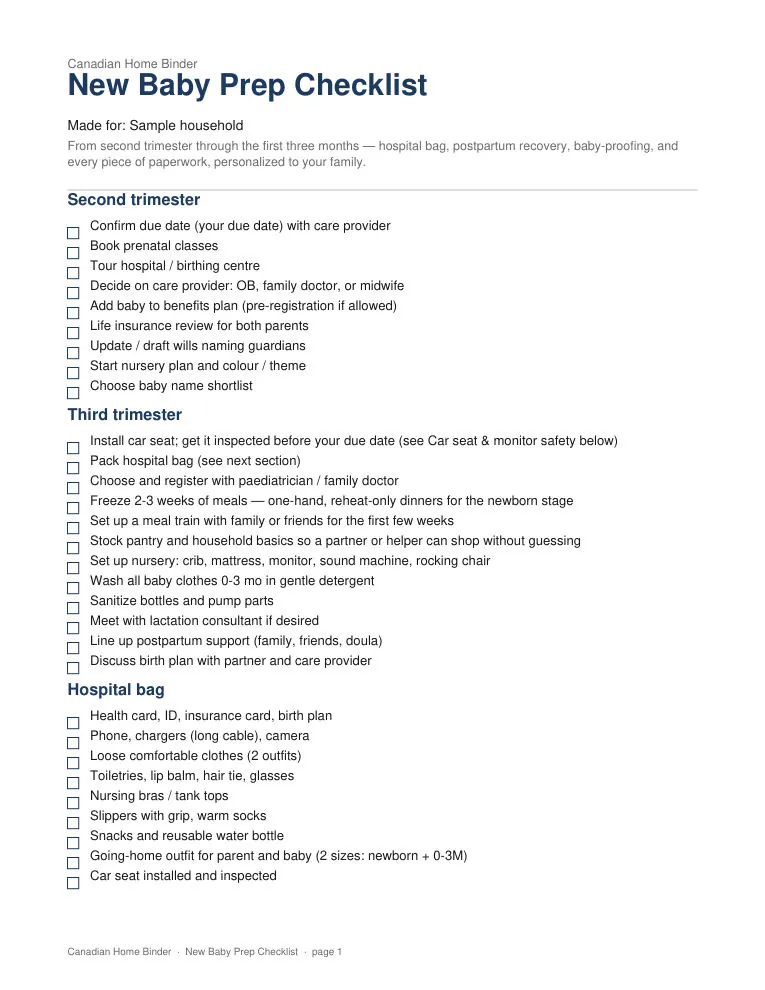
- Built from 10 quick questions about your home
- Only the steps that apply to you, in your order
- Printable PDF, formatted for 8.5×11
- Editable Excel / Google Sheets tracker
- Regenerate any time for 30 days
PDF ExcelReady in seconds after checkout14-day make-it-right guarantee
Get the free PDF first and we'll email you 15% off the personalized version (New Baby Prep Checklist).
Get the Complete Canadian Life Admin Bundle
Get every binder and every personalized checklist we offer. Your bundle includes personalized versions built around your household, plus the original ready-to-use binder PDFs.
Shop the BundleFrequently asked questions
As soon as you stop working — ideally the same week baby is born or you begin leave. Service Canada processes claims in about 28 days; applying late delays payments but doesn't reduce total entitlement.
Related checklists
- Travel & Vacation Checklist for Canadian Travellers
The packing list, plus the Canada-specific parts most checklists skip — provincial health coverage abroad, CBSA limits, and passport validity.
- First Apartment Checklist for Canadian Renters
What to sort before you sign, what to set up before you move in, and the furnishing list that skips what you don't need on day one.
- Meal Planning & Kitchen Organization Checklist
The weekly system, the pantry setup, and the freezer inventory that keep meal planning from collapsing by Wednesday.
- Marriage Checklist for Canadian Couples
Not the wedding-planning checklist — the legal one. The licence, common-law vs. married, and what actually needs updating after.
From the blog
- Baby Teeth Chart: Eruption Order & Ages
The order is more consistent than the timing — most babies follow the same sequence, even when the exact age varies by months in either direction.
- Car Seat Installation Guide: Install It Correctly
A correctly installed car seat shouldn't move more than an inch at the belt path — and the two most common mistakes are a missing tether and a seat that's too loose.
- Baby & Toddler Sleep Schedules by Age (0-24 Months)
Every baby is different, but the ranges are a real starting point — wake windows, nap counts, and total sleep, newborn through toddler.