
Home Safety Checklist for Canadian Homes
The full safe-home audit — fire, radon, flood prevention, electrical, chemical storage, garage safety, and the 72-hour kit — in one printable checklist.
Quick answer
A thorough Canadian home safety checklist covers 9 hazard areas: (1) fire, gas & CO (interconnected alarms, CO and combustible gas detectors), (2) radon (a 91-day test kit, since Health Canada radon levels vary house to house), (3) clean air & mould (humidity control, exhaust fans, HRV/ERV filters), (4) electrical (GFCI, AFCI, tamper-resistant outlets, whole-home surge protection), (5) flood prevention (sump pump plus battery backup, a smart water shutoff like Moen Flo), (6) chemical storage (paint, fuel, and antifreeze out of reach), (7) garage & doors (auto-reverse sensors, a self-closing fire-rated door to the house), (8) child, senior, and pool safety, and (9) a 72-hour emergency kit.
Want this as a printable PDF? It's free.
We'll email you Home Safety Checklist for Canadian Homes formatted for 8.5×11, ready to print.
A safe home isn't about paranoia — it's a 90-minute audit once a year and a few habits that stick, covering the hazards that actually cause damage and injury: fire, radon, flooding, electrical faults, and the everyday chemicals sitting in the garage. Do this checklist every fall alongside the daylight-saving battery change.
Fire, gas & carbon monoxide
- Smoke alarm on every floor AND outside every sleeping area (Canadian building code)
- Interconnected alarms if possible — one goes off, all go off. Smart options (Google Nest Protect, First Alert Onelink) link wirelessly without new wiring
- Test every alarm monthly; replace batteries every daylight-saving change
- Replace alarms every 10 years (check the manufacture date on the back — an alarm that passes the test button can still be past its sensor life)
- ABC-rated fire extinguisher in the kitchen and near the furnace
- Fire escape plan: 2 ways out of every room, meeting spot outside
- Practice the escape plan with kids twice a year
- Keep a bedroom-window escape ladder above the first floor
- CO alarm outside every sleeping area (Ontario, BC, Alberta, and most provinces require it)
- Additional CO alarm near fuel-burning appliances (furnace, water heater, fireplace)
- Test monthly with the test button — a beep confirms electronics, not the sensor
- Replace CO alarms every 7–10 years per manufacturer date
- Annual professional inspection of furnace, water heater, and any gas appliance
- If you use propane (BBQ, tank, or fireplace), a separate combustible gas detector near the appliance or storage — it catches the gas itself, before combustion
- Never run a car, generator, or BBQ in an attached garage — even with the door open
- A backup generator is only ever run outdoors, at least 6 m from windows and doors
- Never use a gas stove or oven for heat
Radon
- Run a radon test kit for at least 91 days — Health Canada's minimum for an accurate long-term reading — in the lowest level of the home you spend time in
- Test in the fall or winter when the house is closed up; that's when radon concentrates highest indoors
- Radon levels vary house to house, even on the same street — a low reading at a neighbour's or a regional average doesn't tell you what's in your own basement
- If your result is at or above 200 Bq/m³ (Health Canada's guideline), plan for a certified radon mitigation contractor
- Retest every 2 years, and again after any major renovation or foundation repair
Clean air & mould prevention
- Bathroom and kitchen exhaust fans vented outside — not just into the attic — and run during and after showers and cooking
- Indoor relative humidity kept between 30–50%, checked with a cheap hygrometer; above 60% is a mould risk
- Basement and crawlspace checked regularly for musty smell, visible mould, or condensation on windows and pipes
- Dehumidifier running in damp basements during humid months, emptied or drained regularly
- Furnace filter and HRV/ERV filter changed on schedule; return air vents not blocked by furniture or rugs
- Portable HEPA air cleaner considered for bedrooms if anyone has allergies, asthma, or you're in a wildfire-smoke-prone region
Electrical safety (GFCI, AFCI, surge protection)
- Tamper-resistant (TR) receptacles anywhere accessible to kids — code-required in new builds, a straightforward retrofit in older homes
- GFCI protection in the kitchen, bathrooms, laundry, garage, and every outdoor outlet — tested with the test/reset buttons
- AFCI breakers protecting bedroom and living-space circuits
- Outdoor outlets covered with weatherproof "in-use" covers, not just a flip-lid
- Whole-home surge protector installed at the electrical panel — covers the furnace, fridge, and everything hardwired that a power-bar surge protector can't reach
- Individual surge protectors on major electronics not covered by a whole-home unit
- No overloaded power bars or daisy-chained extension cords
- Dryer lint trap cleaned every load; dryer vent professionally cleared at least once a year
- No frayed cords, scorched outlets, or switch plates that feel warm to the touch
Flood & sump pump backup
- Sump pump tested by pouring a bucket of water into the pit and watching it cycle
- Battery backup sump pump installed and tested — a power outage during a storm is exactly when the primary pump is needed most
- Water-powered backup sump pump considered as a second layer if you're on municipal water pressure
- Smart water shutoff valve (e.g. Moen Flo) at the main line — it auto-shuts off on a detected leak or unusual flow and is monitored from your phone, which matters most when nobody's home
- Water leak sensors near the water heater, washing machine, dishwasher, and sump pit, with phone alerts turned on
- Window wells cleared of debris and covered
- Backwater valve on the main sewer line if you're in an older or flood-prone neighbourhood — check with your municipality
- Downspouts extended at least 1.5 m from the foundation, grading sloped away from the house
Chemical & hazardous materials storage
- Paint, solvents, and oil-based products in a sealed, ventilated cabinet — ideally the garage or shed, not living space
- Gasoline and other fuel in an approved container, away from any ignition source, the furnace, or the water heater
- Antifreeze and windshield washer fluid stored up and out of reach of kids and pets — antifreeze is sweet-tasting and a genuine poisoning risk
- Household cleaners and pesticides in a locked or high cabinet, kept in their original containers
- Pool or spa chemicals stored separately from each other and from other household chemicals — some combinations release toxic gas
- A working CO detector near the garage-to-house door if any fuel-burning equipment is ever run or stored in the garage
Garage & doors
- Garage door opener's auto-reverse safety sensors tested — a roll of paper towels in the door's path should trigger a reverse on contact
- Garage door opener keypad code changed from the factory default; remotes not left in an unattended vehicle
- Self-closing, self-latching fire-rated door between an attached garage and the house — required by code in most of Canada and one of the most commonly skipped items
- Weatherstripping on the garage-to-house door in good condition to keep exhaust and cold air out
- Deadbolts on all exterior doors, in addition to the doorknob lock
- Sliding patio or garage-adjacent doors have a secondary bar or pin lock, not just the factory latch
Break-in prevention
- Deadbolt on every exterior door (Grade 1 or Grade 2)
- 3-inch screws in the strike plate — the door frame is the weak point
- Reinforce or replace hollow-core exterior doors
- Window locks on all ground-floor and easily accessible windows
- Motion-activated lighting at every exterior door and dark side of the house
- Video doorbell or exterior camera at the main entry
- Trim shrubs below window height (no hiding spots)
- House number visible from the street for emergency services
- Timers on lights when travelling — vary the pattern
Kids + pet safety (0–5 years and always for pets)
- Outlet covers on every unused outlet
- Baby gates at top AND bottom of every staircase
- Furniture (dressers, bookcases, TVs) anchored to studs
- Blind cords cut short or replaced with cordless — strangulation risk
- Cleaners, meds, and vitamins in a locked upper cabinet
- Toilet locks on lower-floor bathrooms (drowning risk under 5)
- Stove knob covers + oven lock
- Pool or hot tub: 4-sided fence with self-latching gate (provincial code)
- Pet-safe: chocolate, xylitol gum, grapes, cleaners all out of reach
72-hour kit + family emergency readiness
- 72-hour kit: water (4L per person per day), non-perishable food, can opener
- Battery/crank radio, flashlights, spare batteries
- First aid kit + 7 days of any prescription medications
- Cash in small bills (ATMs and cards fail in an outage)
- Copies of ID, insurance, prescriptions in a waterproof pouch
- Whistle, dust masks, garbage bags, wet wipes
- Pet food + carrier, kids' comfort items
- Family emergency plan: out-of-town contact, meeting spot, kids' schools
- Register for provincial + municipal emergency alerts (Alert Ready is national)
Practical tips
- Do the full audit every fall when you change the clocks — it takes 90 minutes and covers you for a year.
- Take a video walkthrough of every room with drawers and closets open. It doubles as your home-insurance inventory.
- Post the family escape plan + emergency contacts inside a kitchen cupboard. Everyone in the house should know where it is.
Sources
- Health Canada — Guide for radon measurements in homes
- Kidde Canada — When to replace smoke & CO alarms
Deadlines, dollar figures, and thresholds above were checked against these sources — July 2026. Rules change; always confirm current figures at the link before relying on them.
This page is free. Here is what CA$9 adds.
A room-by-room, hazard-by-hazard safety audit for your household — fire, radon, flood, electrical, and more.
Free · this page
Home Safety Checklist for Canadian Homes
- Every item on this page
- Printable PDF by email (free)
- Same list for every household
- No spreadsheet to track progress
Personalized · CA$9 one-time
Home Safety Checklist
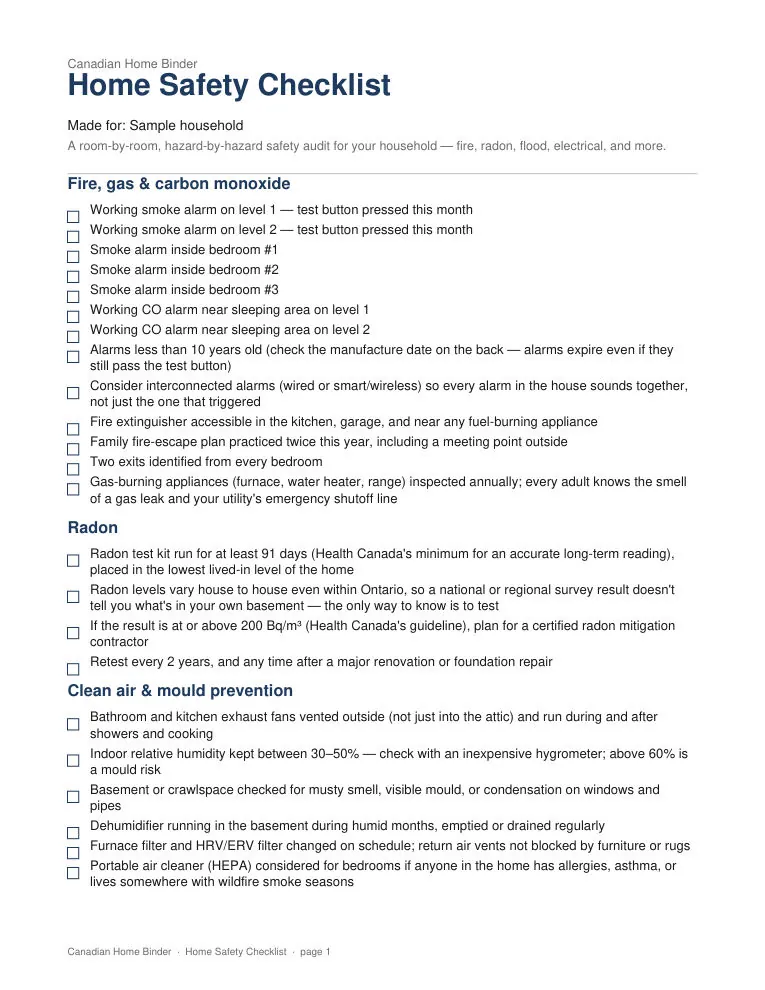
- Built from 12 quick questions about your home
- Only the steps that apply to you, in your order
- Printable PDF, formatted for 8.5×11
- Editable Excel / Google Sheets tracker
- Regenerate any time for 30 days
PDF ExcelReady in seconds after checkout14-day make-it-right guarantee
Get the free PDF first and we'll email you 15% off the personalized version (Home Safety Checklist).
Get the Complete Canadian Life Admin Bundle
Get every binder and every personalized checklist we offer. Your bundle includes personalized versions built around your household, plus the original ready-to-use binder PDFs.
Shop the BundleFrequently asked questions
Yes in most provinces — including Ontario, BC, Alberta, Manitoba, Nova Scotia, and Yukon — for any home with a fuel-burning appliance or an attached garage. Check your provincial building code for exact placement rules.
Related checklists
- Travel & Vacation Checklist for Canadian Travellers
The packing list, plus the Canada-specific parts most checklists skip — provincial health coverage abroad, CBSA limits, and passport validity.
- Camping Checklist for Canadian Trips
Shelter, kitchen, clothing, and the bear-safe food storage rules Canadian backcountry actually requires.
- First Apartment Checklist for Canadian Renters
What to sort before you sign, what to set up before you move in, and the furnishing list that skips what you don't need on day one.
- Meal Planning & Kitchen Organization Checklist
The weekly system, the pantry setup, and the freezer inventory that keep meal planning from collapsing by Wednesday.
From the blog
- Best Radon Detectors for Canadian Homes (2026)
Health Canada's guideline is a 91-day test, not a 5-minute reading — these four options actually meet that bar, from a $55 lab-analyzed kit to a $380 whole-home monitor.
- The Home Safety Checklist Every Household Runs
Fire, carbon monoxide, break-ins, kids and pets, and the 72-hour kit — one audit, once a year, timed to daylight saving.